
AI in Manufacturing: 4 Systems That Work on the Shop Floor
October 8, 2026
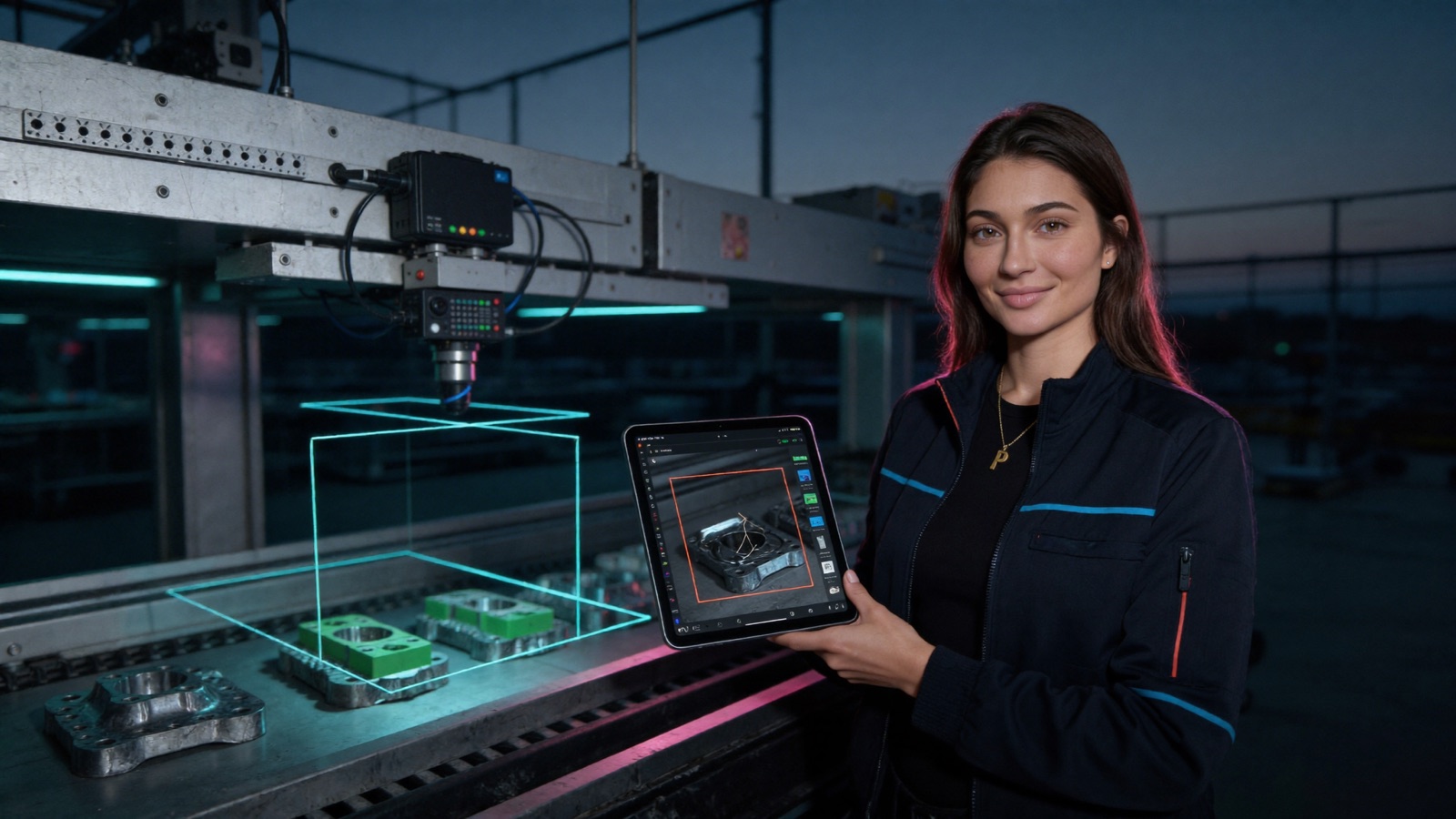
AI in manufacturing usually brings two images to mind: a robot assembling a car on its own, or a chatbot writing emails. Both are misleading. In a plant with a few dozen or a few hundred people, AI pays for itself in far less glamorous places: at the quality inspection station, next to a machine that starts to sound different, in the binder of service manuals and in the ERP where someone retypes orders every day.
Below are four systems we build for manufacturers and distributors. For each one: what problem it solves, when it makes sense and when you should leave it alone.
1. AI machine vision for quality control
Quality control is the most common entry point for AI on the shop floor, because the problem is easy to measure. An operator inspects parts for eight hours, fatigue builds, and a defect that reaches the customer costs a complaint, shipping and trust.
A machine vision system is a camera, lighting and software that judges every part from an image. Classic vision systems follow rules written by a programmer: measure the diameter, count the holes, check that the label sits in the frame. They work well as long as the product and lighting are repeatable.
AI adds what rules struggle with:
- defects that vary in appearance: scratches, pits, discolouration, inclusions, burrs,
- products that differ between batches in shade, texture or small tolerances,
- assembly completeness checks when parts can sit in several valid positions.
The model learns from images of good and defective parts from your own line. The result does not end on a screen: the system signals the PLC or reject unit, archives the defect image and adds it to the shift report.
When it makes sense: inspection is manual today, defects vary, and an escaped defect is expensive. When it doesn't: if you measure one dimension under constant conditions, classic vision will be simpler and cheaper. We say so during the analysis.
The most important step is a feasibility test before buying hardware: on images from your production we check whether the defect is detectable at the required accuracy. Only then do we choose cameras, optics and lighting.
2. Edge AI: the decision happens at the machine, not in the cloud
A line camera taking several images per second produces a lot of data. Sending all of it to the cloud is expensive, slow and often impossible: Wi-Fi on the shop floor is unreliable, and IT does not want production images leaving the plant.
That is why the AI model increasingly runs directly on a device next to the machine. This is edge AI: computing at the edge of the network, where the data is created. Only the result goes to the server, for example "part 4812 rejected, scratch, image archived".
In manufacturing, edge AI works best in three areas:
- Real-time quality control: the decision takes a fraction of a second, within the line's cycle time.
- Machine condition monitoring: a vibration or temperature sensor, or a microphone next to a bearing, detects that a machine is behaving differently before it fails.
- Counting and identification: counting parts and packages, reading markings, checking pallets before loading.
Sometimes off-the-shelf hardware does not fit the conditions: no space, dust, vibration, unusual power. Then we build our own electronics and a device prototype, and optimise the AI model for its memory and power budget. The same approach applies to on-premise AI clusters, when a company wants language models but cannot send documents to outside providers.
3. A private knowledge base: manuals, training and meetings in one search
Every plant has a few people who "know where everything is": which manual has the tightening torque, what was agreed with the customer in September, how to change over a machine for a new format. When they are on holiday or leave, that knowledge goes with them.
An AI knowledge base solves this differently from yet another shared folder. Employees ask in plain language, and the system answers from your own material, with a source for every sentence:
- documents: service manuals, procedures, routing sheets, standards and quotes, with the page number,
- video: on-the-job training and shop-floor recordings, linked to the exact minute,
- audio: meeting and call recordings, with the relevant transcript passage highlighted.
Privacy is the key. Manufacturer manuals, technical drawings and shop-floor recordings are data companies do not want in public chatbots. That is why the knowledge base can run entirely on your own server or AI cluster, language model included, and each employee only sees material they have permission to access.
4. An MCP server: AI that works inside the ERP, not next to it
The fourth system is the least visible but often saves the most time. Most office work around production is moving information between systems: the order from an email into the ERP, stock levels into a quote, delivery status into a customer reply, production data into a report.
AI agents can take over this work, but only if they can access company systems. That is what MCP (Model Context Protocol) is for: an open standard through which AI models connect to external systems. An MCP server gives the agent specific tools, such as "check stock", "show the customer's order history" or "draft a quote", and controls what the agent may do.
Two rules we always follow:
- The agent never gets direct database access. It gets clearly named tools with data validation and limits.
- Write operations require human approval. Reading can be automatic; changing data in the ERP cannot.
Where to start
These four systems complement each other: an edge AI camera detects a defect, the result goes through the MCP server to the ERP and the shift report, and the technician fixing the root cause asks the knowledge base for the procedure. But you do not need to build everything at once, and usually you should not.
The best first project meets three conditions: the problem can be measured, the data already exists, and the result can be checked within a few weeks on one station or in one department.
A few honest caveats: AI will not fix a broken process, models need retraining as new variants and defects appear, and access to data and systems usually takes longer than building the model.
We are based in Wrocław, Poland, with a background in automation and robotics, and we build electronics and prototypes ourselves. If you want to find out which of these systems makes sense in your plant, book a free consultation.